Onions, August 2026
My mother often started making a dish by peeling and dicing or slicing an onion or two. My cooking usually involves onions as well. They really do add flavour to a dish. Some folks don’t like onions cooked or raw. As a child, I liked them raw less than I do now. They say children taste things more acutely than adults. Over time I really learned to enjoy them raw in small amounts. A thin slice on a burger or a few green onions in cucumber salad really add to the culinary experience. Cooked onions are heaven to me.
Recently, I was involved in an eco and natural dye workshop. Eco dyes and natural dyes involve using plants to create colour on fabric or paper. It was a big chemistry lesson. We used a number of different chemicals as well as heat to extract the colour from plants. Sometimes we used the flowers, leaves and stems. For some plants, roots can also be used. In the case of the Onion, we used the dried skins from the outside of the Onions. I keep a bowl on my kitchen counter where I deposit my skins when I peel an onion. They can be kept for years in their dried form.
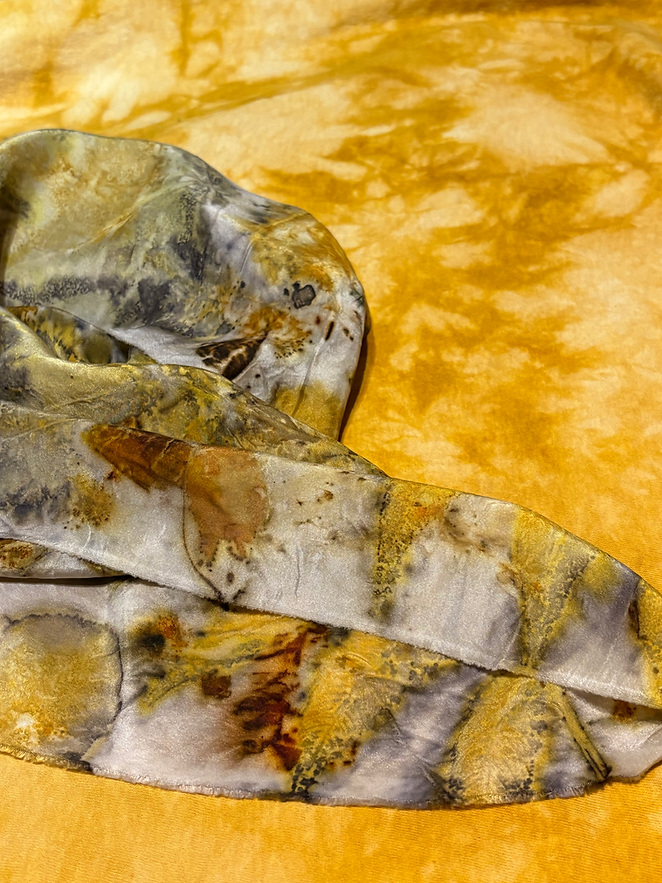
To make a natural dye from onion skins you put the dried skins in a pot and work them with your hands for a bit to help release the colour. After that you simmer the skins for an hour or two, adding more water as needed. You need to treat the cloth you intend to dye with some common chemicals and dry it. After this it was dipped in a chalk solution which helps set the dye, then it was added to the dye pot. The t-shirt you see in the photo was boiled in the onion dye bath for a period of time, until a good colour was reached. If I had dipped the onion skin dyed fabric in a vinegar or an iron solution after I removed it from the pot the colour would have been different. Vinegar tends to lighten the colour and iron deepens it and often greys the colour. The bright yellow appealed to me so I left it alone. It did look more orange when it came out of the pot but lightened as it dried.
The silk scarf in the photo was dyed using an eco-dying method. The scarf was dipped in a titanium solution and placed on a length of aluminum foil. Leaves and plant materials were placed on top. A length of cotton was dipped in an iron solution and it was put on top of the plant materials. Then, starting at one end the layers were rolled tightly around a piece of doweling that was first covered with aluminum foil. The bundle was suspended over boiling water and steamed for two hours. The bundle was allowed to cool and then unrolled to reveal the transfer of the tannin from the plant material to the fabric. Different leaves and plant materials give different colours. The bright orange spots you see are the result of dried onion skins being dropped among the leaves and other plant bits. The black edges around the leaves are the result of the iron interacting with the tannin in the leaves and transferring to the fabric. Both items turned out rather well. I look forward to wearing them.
It just goes to show that ordinary things we have in our homes or growing in our environment can be transformed into colour and beauty with a bit of effort and some good instruction. Thanks go to Chandra Rice for teaching us.


Comments